Modular Tent Buying Guide: Maximizing Your Clearspan Space and Investment
For serious buyers, a modular tent is a significant capital investment, serving as your temporary warehouse, workshop, or major event venue. Selecting the correct technical specifications is crucial for long-term operational efficiency.
Key Factors for Technical Specification
1. Footprint & Clearspan Space
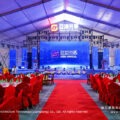
The footprint is the tent’s length and width, determining its total capacity. Critically, modular tents utilize a Clearspan design, meaning the interior has no support poles. This ensures 100% usable space, maximizing efficiency for equipment or guests.
- Capacity Planning: Beyond core needs, always reserve extra operating room for aisles, buffer zones, or office partitions.
- Recommendation: If you need 500 square meters of storage, aim for a larger tent to ensure comfortable operation space.
- 【Picture Insertion Point: Clearspan interior demonstrating 100% usable space】
2. Effective Height (Side Walls)
Height is vital for commercial functionality. We focus on Side Height (Eave Height), which dictates the free movement of large machinery, forklifts, or trucks inside.
- Commercial Standard: Most commercial tents have a side height of at least 3 meters (approx. 10 feet). Higher walls are necessary for multi-level racking or large vehicle access.
3. Frame Structure and Stability
The frame—often galvanized steel or aluminum—determines the tent’s wall design.
- Vertical Walls: Strong frames allow for nearly vertical walls. This maximizes floor space utilization, letting you place shelving or equipment right against the wall.
- Angled Walls: Tents with a slight slope are often more stable in heavy wind and rain, better dispersing pressure and stress. This might be the better choice for environments exposed to severe weather.
- 【Picture Insertion Point: PVC fabric and aluminum/galvanized steel frame joint】
The Smart Buyer: Evaluating Your Total Investment
Never focus solely on the initial price. Consider this a capital investment. An aluminum frame may have a higher initial cost than a galvanized steel frame, but its corrosion resistance and lighter weight can lead to significant long-term savings in maintenance and labor.
The total cost is influenced by the frame’s strength, the grade of PE/PVC fabric (fire-rated, UV-protected), and the complexity of the installation environment. Choosing a low-spec option to save money upfront can result in huge losses from structural failure during adverse weather—a risk far outweighing the initial savings.
The right modular tent choice ensures reliability, flexibility, and Clearspan efficiency for your project. Ready to find the optimal solution for your temporary or semi-permanent need? Submit your project requirements today for a customized consultation that breaks down all key investment factors.