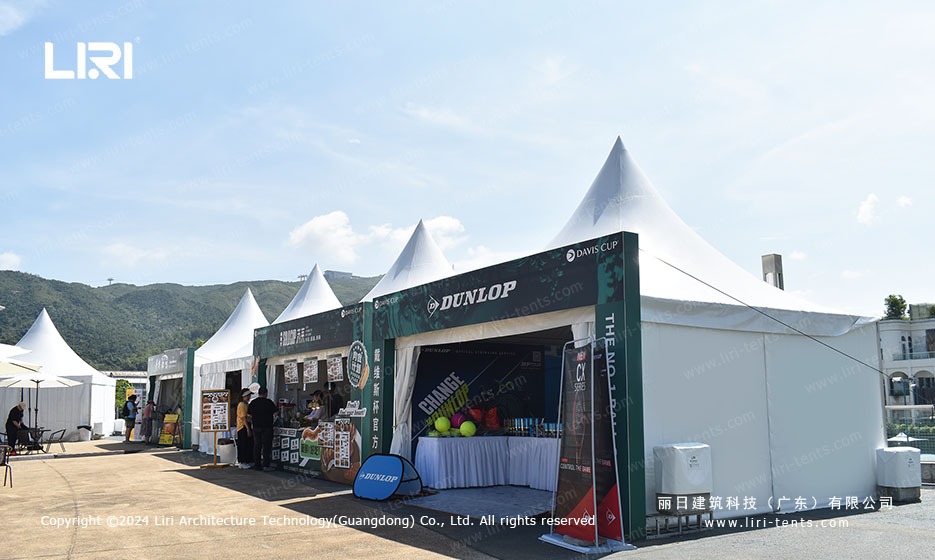
A Davis Cup-style tennis tournament puts a flood of requirements onto a compact urban venue, and the Hengqin stop is a textbook case.
Within a few hundred metres of the centre court the organizers had to fit sponsor booths, fan experiences, food stalls, medical support, a media check-in, four staff gates, and a long security-screening hall. A single tent type could not cover the brief, so the deployment paired classic pagoda tents for the small-footprint zones with an event marquee hall for high-volume screening. The result is a tour-grade overlay that can be struck within days once the trophy is lifted.
Site Challenges at a Tennis Tournament Venue
Tennis events are unusually demanding on temporary structures because the spectator flow has to keep moving at peak changeovers. The Hengqin site sits inside a dense urban block with the main stadium on one side and a service road on the other, so every square metre has to earn its keep.
Sponsor activations needed clear branding walls; VR fan zones needed blackout fabric; food tenants needed extract ducts and water inlets; medical teams needed privacy screens; and the security hall had to absorb metal detectors, X-ray units, and crowd-control barriers. A typical outdoor event tent program at this scale uses three to five distinct tent families, which is why the layout is planned long before the first aluminum profile is bolted.
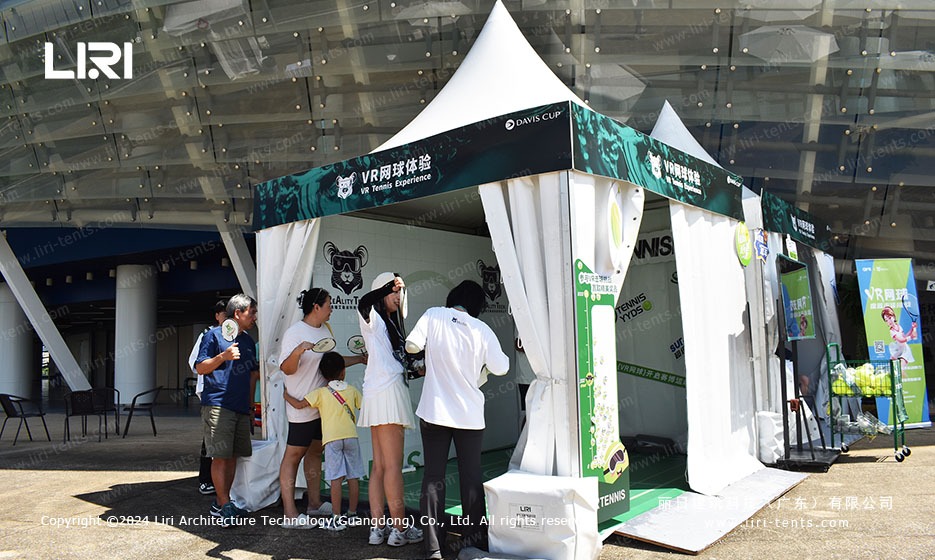
Pagoda Tents for Sponsor and Fan Experience Zones
The peaked-roof pagoda is the workhorse of any tournament overlay, carrying most of the interactive zones on this site. Each unit was built on a hard-pressed 6061/T6 aluminum frame clad in opaque white PVC, with a 3 m × 3 m, 4 m × 4 m, or 5 m × 5 m footprint that can be repositioned in minutes.
The high peak gives visitors a tall interior for VR rigs, retail counters, or trophy displays, and the fabric walls can be removed on the open side to create a wide flow-through. The same pagoda modules have been used for the pagoda tents for HK food festival, which is one reason organizers trust the system for back-to-back deployments. The white-on-white palette also photographs well for broadcast, an underrated requirement at events.
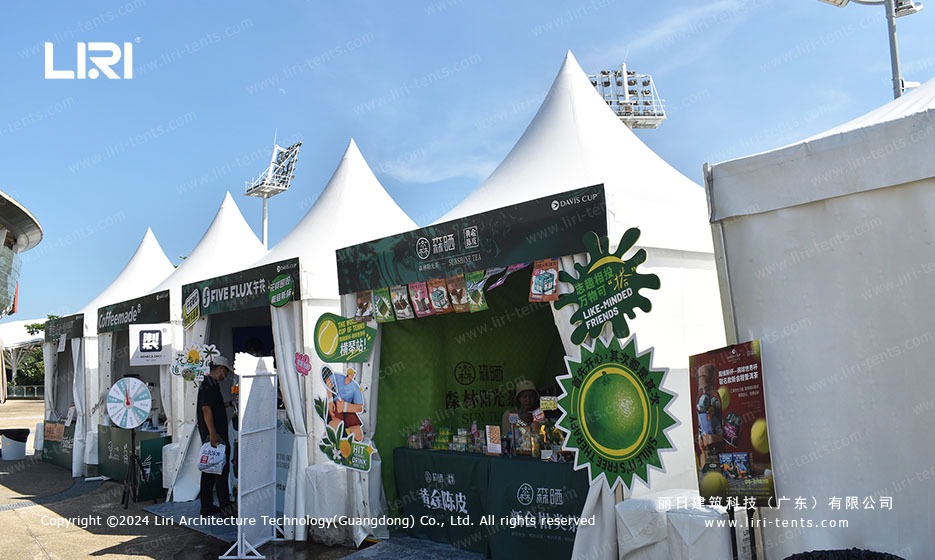
F&B and Concession Pagoda Rows
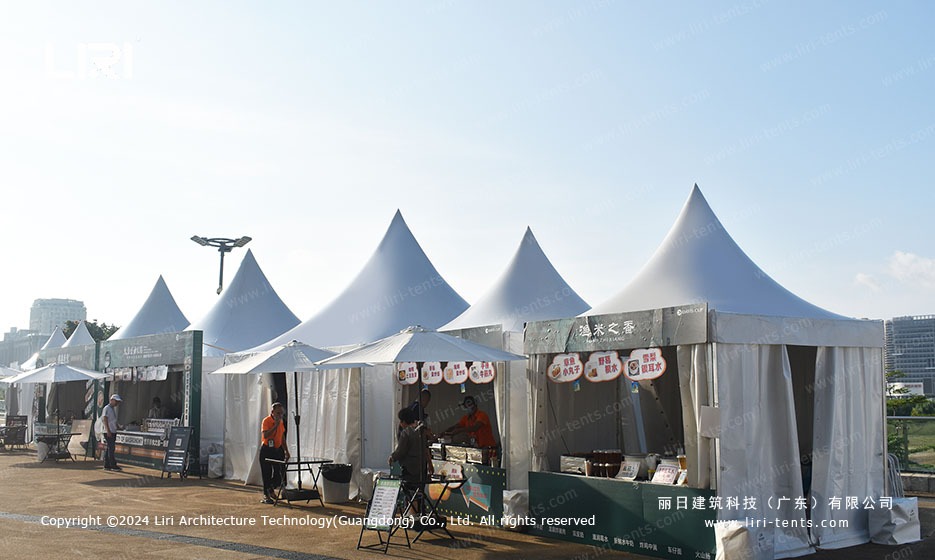
Food and beverage is the largest tent category at a tennis event, and the F&B strip at Hengqin shows the pattern. A line of pagoda tents was bolted together with shared gutter channels and rain strips, turning what would be eight or nine separate stalls into one continuous covered walkway.
Tenants received independent counters and signage, but the shared roof kept queues dry during a typical afternoon downpour. The 5 m spacing between frames leaves room for a 1.5 m service corridor behind each stall, where cables, water lines, and refrigeration units can be routed without entering the public space. The same approach has been used for the China Open sport tent for outdoor tennis event program, where organizers wanted identical sightlines along a longer concession row.
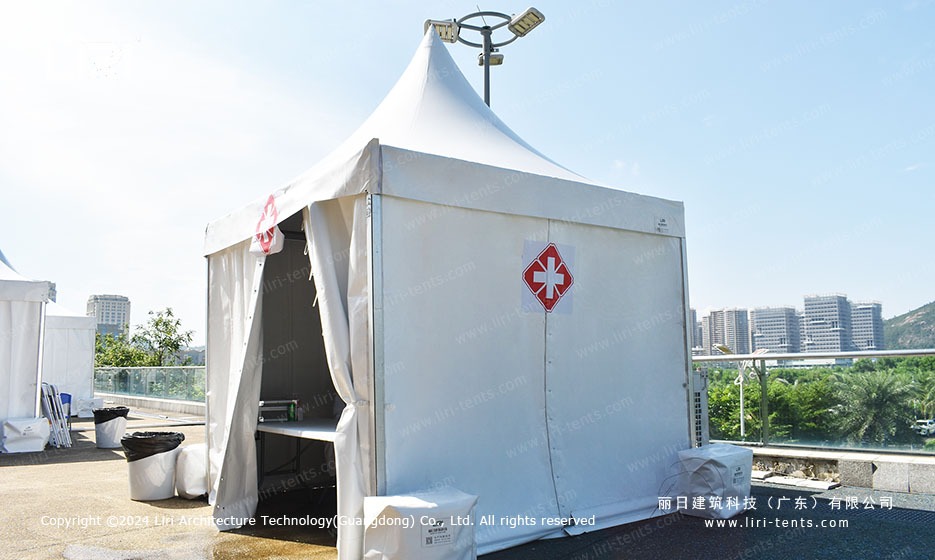
Medical, Security, and Gate Entrance Modules
Smaller pagoda units took on the support roles. A 4 m × 4 m medical station carried the red-cross signage on every side and was positioned within 90-second reach of the main stand, with a stretcher-accessible door on the gable end.
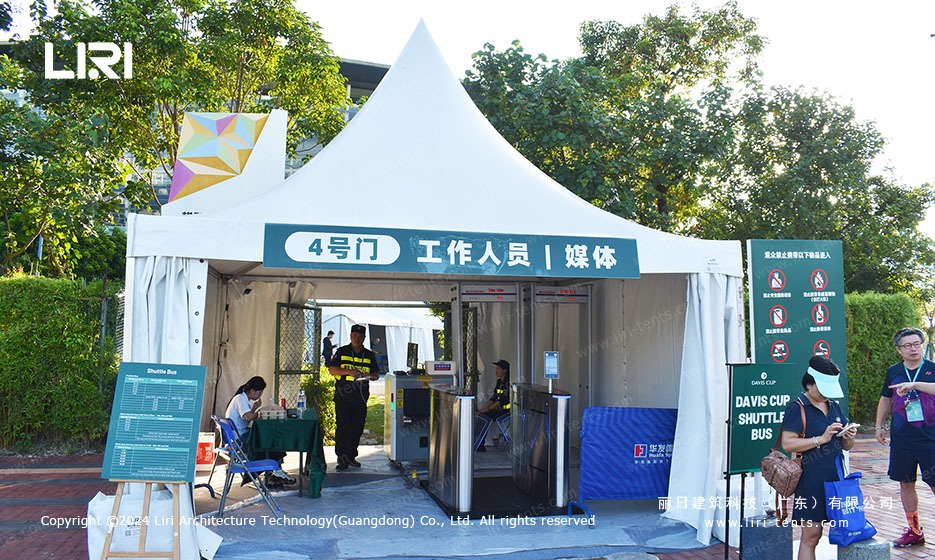
Across the plaza, a series of 5 m × 5 m gate pavilions served as Gate 4 staff and media entrances, with hard PVC walls on the back, fabric curtains on the front, and a small desk for credential checks. Marquee tent units in this size class are the right answer when a single queue or desk needs to be protected from sun and rain.
A-Frame Marquee for the Security Screening Hall
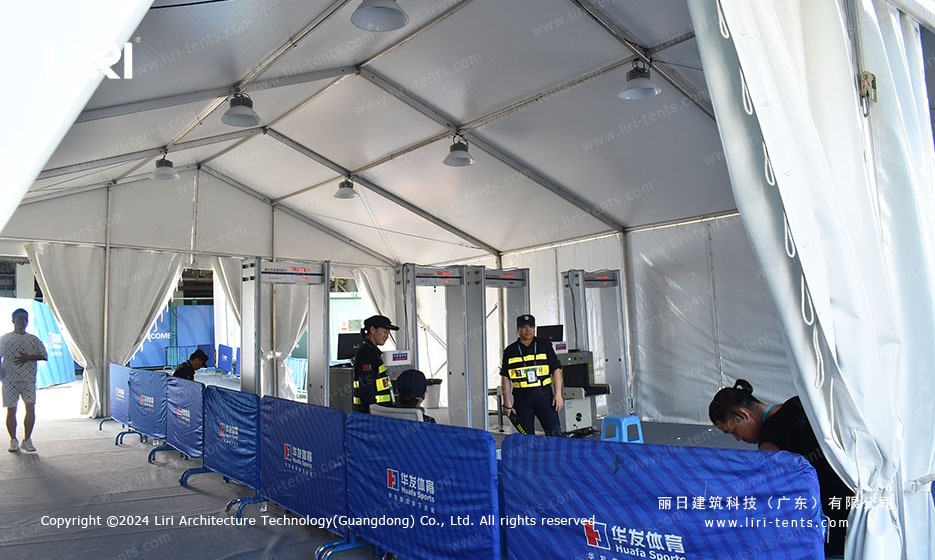
The single largest structure on site is the security hall, built as a clear-span A-frame marquee large enough to absorb metal-detector arches, X-ray tables, and barrier queues.
The 15 m × 30 m hall uses an extruded aluminum frame and an opaque white roof that keeps interior temperatures lower than a clear-span fabric would, and the long sides are finished with hard PVC walls for wind protection. Lighting is hung from the ridge bar so the hall can run on a single 32-amp feed. Similar screening halls have been used in hot marquee tent for outdoor sports event deployments, scaled up for marathon and triathlon events where entrants have to clear a checkpoint inside a tight window.
Court-Side Equipment and Player Service Tents
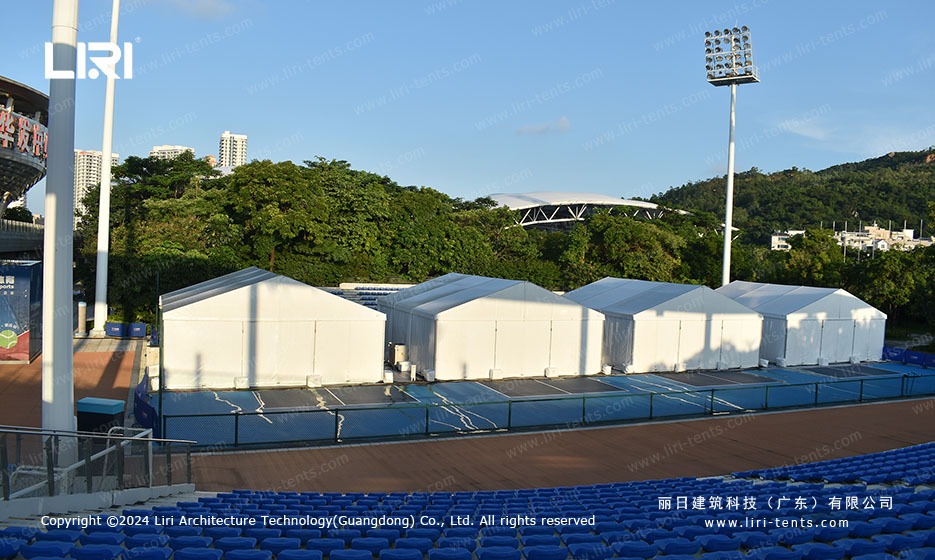
Along the back of the stadium bowl, a row of large A-frame tents was used for player service, physio rooms, and broadcast storage. These structures sit on the apron between the seating bowl and the practice courts, so they have to handle sun, gusts, and a stream of trolleys without leaking or drifting.
The covered apron doubled the usable service area during changeovers and gave the broadcast crews a clean cable run from the mixed zone to the compound. A wider view shows the A-frame rows step back from the spectator zones, leaving the pagoda line closer to the public and the heavier halls in the back-of-house. Sports marquee tent programs at this scale are usually designed with a buffer zone between public and operational areas, and the Hengqin plan follows the same logic.
Frequently Asked Questions
How many distinct tent types are used at a Davis Cup-style tennis event?
Most major tennis overlays use three to five families: pagoda tents for sponsor and F&B zones, A-frame halls for screening and storage, glass-wall pavilions for media centres, and small kiosks for ticketing. The Hengqin deployment paired pagoda units with an A-frame security hall and a back-of-house A-frame row.
Why are pagoda tents preferred for tennis tournament sponsor booths?
The peaked roof gives a tall interior and a strong branding surface on the gable end, while the 3 m to 5 m footprint can be added or removed as the sponsor list evolves. White PVC fabric also photographs well for broadcast.
What tent size fits a tennis security screening hall?
A 15 m × 30 m clear-span A-frame is a common benchmark because it can absorb multiple metal-detector arches, X-ray units, and a queuing barrier without crowding. The roof is usually opaque white to control heat gain.
Can a tennis overlay handle an outdoor rainstorm?
Yes. The PVC fabric is waterproof and UV-stabilized, the frames are rated for typical coastal wind loads, and the gutter system channels water away from concession and entry zones. Anchoring is by steel base plates or expansion bolts.
How quickly can a tennis tournament overlay be struck?
A trained crew can dismantle a pagoda row in a day and a clear-span A-frame hall in two to three days, which is why tour organizers treat the overlay as a build-strike-build program between cities.
For organizers planning a tennis, padel, or other racquet-sport event, a mixed pagoda and A-frame overlay remains the most efficient way to cover sponsor, F&B, security, and back-of-house zones on a tight urban footprint.
The Hengqin plan shows how the two systems can sit side by side without visual conflict, and the same engineering can be re-used at frame marquee for tournament bracket programs or scaled up for a multi-court sports park.
Planning a similar build in the Gulf? Our Middle East marquee tent guide covers regional structures, sizing, and deployment notes for Dubai, Doha, and Riyadh.
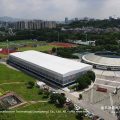 20m x 118m TFS Curve Structure Tennis Court Marquee for 8-Court Sports Park
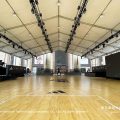 25m Clear Span Exhibition Marquee: Shanghai Urban Plaza Sports Arena
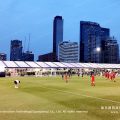 Transparent Marquee Tent for FIFA Fan Zone in Thailand: 20m Clear Span Build
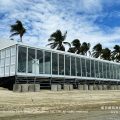 Motorsport VIP Marquee Tent: Beachside Racing Hospitality Solution
 Multi-Functional Frame Tents: Shaping The New Games Experience
 How a Clear Span Sports Court Marquee Created a Year-Round Basketball Arena