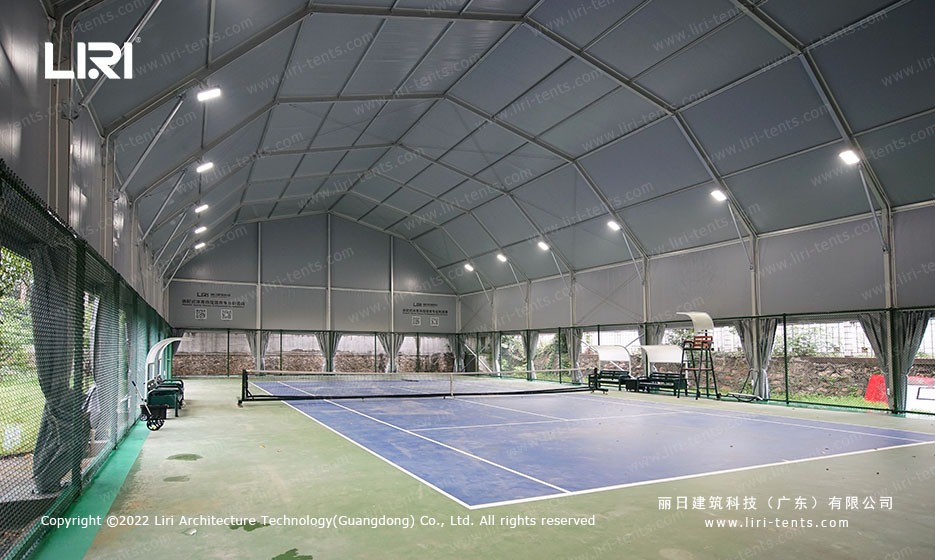
A frame decision arrives on every marquee RFQ long before anyone talks about floors or linings: should the structure be aluminium or steel? The two metals both build sound clear-span marquees, and both appear across the commercial market. What changes between them is not a simple quality ranking but a set of tradeoffs in freight weight, crew effort, corrosion upkeep and entry price. This article walks through those tradeoffs the way a procurement team should weigh them, then gives you a specification checklist that matters more than the metal name on the quotation.
What the Frame Does in a Clear-Span Marquee
The frame carries the structure; the membrane only covers it. In a modular clear-span system, extruded beam profiles form the roof trusses and the upright legs, bays are added to reach the required length, and the whole assembly stands on anchoring that transfers loads into the ground. Spans on this site run from 3 to 80 m as standard, with custom widths engineered beyond that, as set out on the marquee tent specifications page.
Because the frame does the structural work, its material affects how the tent behaves over years of use and how much it costs to move, inspect and maintain. Neither metal is automatically the better engineering choice. Both can be specified well or badly. The real question is which tradeoff profile fits the way your organisation will use the structure.
Weight Changes Freight, Crew and Bay Handling
At material level the difference is physical: aluminium is roughly one third as dense as steel. Profile geometry differs between designs, so you cannot divide one frame weight by another, but the density gap shows up everywhere that material accumulates: long beams, truss chords, purlins and legs.
For a buyer, that gap converts into three practical effects. First, handling: lighter bays need fewer crew members to lift, position and bolt, and they reduce the strain of repeated setups for a hire fleet. Second, vehicle capacity: a truck that carries more bays per trip makes fewer trips on a multi-tent project. Third, freight: a lighter frame packs more structure into each container, which lowers the shipping cost per bay on an international order. How that packing works, and what the packing list must show, is covered in our container loading and export packing checklist.
Weight is only an advantage, though, when the structure actually travels. A marquee that is erected once and stays up for years gains far less from a lighter frame.
How Each Metal Ages Outdoors
Aluminium alloys used in structural work form a thin oxide layer on exposure to air, and that layer protects the metal beneath it. Hard anodising, which is how the 6061-T6 profiles on our structures are finished, thickens that protective layer further. The practical result is that an aluminium frame ages mainly by denting or scratching, not by rusting through.
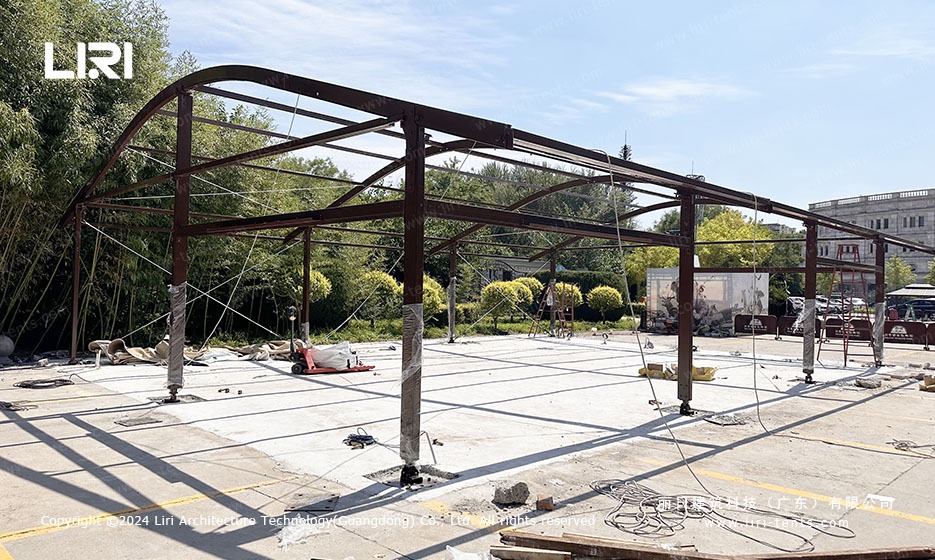
Steel is stronger than aluminium at the same geometry and holds up well, but outdoors it depends entirely on its protective system: galvanising, paint or powder coating. Sound coating means long life; a chip or scratch at a joint lets corrosion start, and it spreads under a failed coating. That is why steel structures need periodic coating inspection, especially at connection points and ground-level feet. Note one caveat that applies to both materials: fasteners, pins and cables are often steel even on an aluminium structure, so a corrosion inspection routine is part of owning either frame.
Where Steel Still Deserves a Look
A fair comparison has to say where steel wins. It is stiffer than aluminium at the same tube geometry, which matters on some fixed installations. Its entry price is usually lower for a comparable commercial configuration. And the extra mass can be neutral or even useful on a semi-permanent industrial cover that is anchored once and never moves, where nobody lifts the bays by hand.
What steel’s weight is not, however, is a performance number. A heavier frame is not automatically a stronger frame; documented load capacity, profile design and anchoring specification are what decide that. Judge both materials on written engineering data, not on which quotation feels heavier.
The Specification Checklist That Matters More Than the Metal Name
Whichever material a supplier quotes, demand the same written details before comparing prices:
– Alloy and temper for aluminium, or steel grade: an unspecified alloy is a red flag. Our structures use 6061-T6 extruded profiles, a temper chosen for structural work.
– Profile shape, outside dimensions and wall thickness for each member type, not just “aluminium frame”.
– Connector design: joints concentrate forces, and machined or cast connectors with bolted assemblies behave differently from improvised welds. The corner joint in the photo below is where a frame is judged.
– Fastener type and replaceability.
– For steel, the coating system in writing; for aluminium, the surface treatment such as hard anodising.
– Anchoring specification: engineered anchors sized for the project, in place of standard expansion bolts. On our aircraft hangar marquee project in Xi’an, the anchoring system was rated at 30 kN per point for precisely this reason.
– Membrane certification alongside the frame: our PVC covers meet DIN 4102 B1 and NFPA 701 flame-retardancy requirements.
Local wind, snow and fire regulations vary by country and municipality, so confirm compliance against your project location with a qualified local engineer before ordering.
Matching the Material to Your Operating Model
| Operating model | Transport pattern | What to weigh most |
|---|---|---|
| Touring hire fleet | Bays move weekly or seasonally | Handling weight, container fill, corrosion-free storage turnover |
| Semi-permanent industrial or event cover | Erected once, stays for months or years | Documented loads, coating or finish quality, anchoring design |
| Fixed venue with rare moves | Static installation | Entry price, coating maintenance plan, connector durability |
If your operation matches the first row, aluminium is usually the efficient choice, and our aluminium frame marquee range is built around exactly that use. If it matches the second or third, steel remains a legitimate option to price alongside aluminium. Either way, our guide to the key tent features to compare before buying lists the rest of the specification, from membrane to accessories, that should appear on every offer you request.
Tell us your span, application and project location, and our engineering team will return a framed quotation with the material, profile and anchoring data set out in writing. Reach the team through our contact page to start that conversation.
 Marquee Price per Square Metre: What the Figure Hides in a Quotation
 Marquee Factory Audit: What to Check Before You Place the Order
 Marquee Pre-Shipment Inspection: A Buyer Checklist Before Balance Payment
 Custom Span Marquee Tents: Specifying a Made to Order Width
 How a Clear Span Sports Court Marquee Created a Year-Round Basketball Arena
 Pagoda & A-Frame Marquee Layout for Davis Cup-Style Tennis Tournament at Hengqin