The Challenge: Weather Limits Court Time
Basketball facilities in temperate climates lose months of play to seasonal conditions. Summer heat makes midday sessions uncomfortable. Winter rain and cold keep players away. A permanent brick-and-mortar building costs heavily and faces long construction timelines. Facility operators needed coverage that arrived fast and performed for years.
A clear span marquee tent answers this need. Unlike pole-supported structures, the clear span design removes every interior column. Players get 100% unobstructed floor space from sideline to sideline. Coaches run drills without dodging support posts.
Why Clear Span Marquee Tents Fit Sports Courts
Clear span marquee tents carry loads through perimeter trusses rather than center poles. This architecture matters for sports because:
- Full court dimensions fit without column interference
- Overhead lighting and scoreboards mount freely
- Ball trajectory stays clear across the entire span
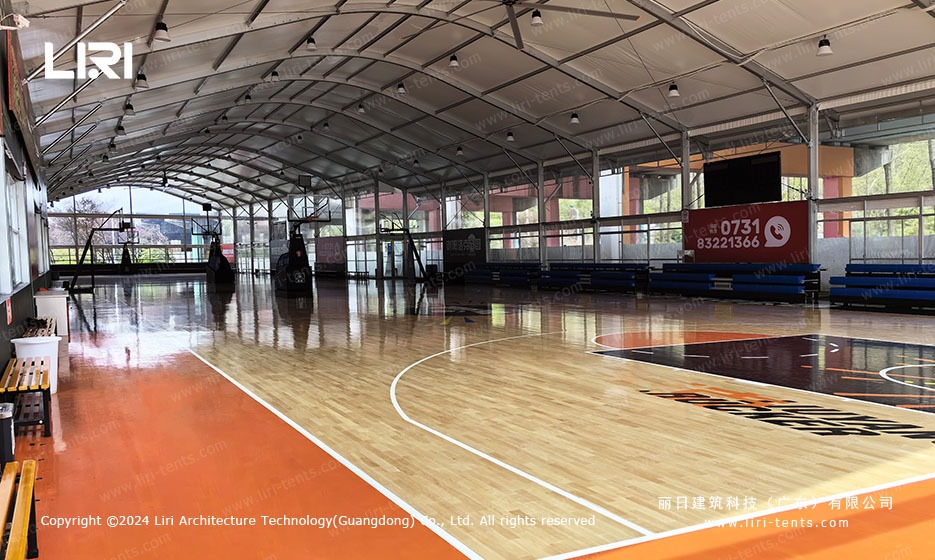
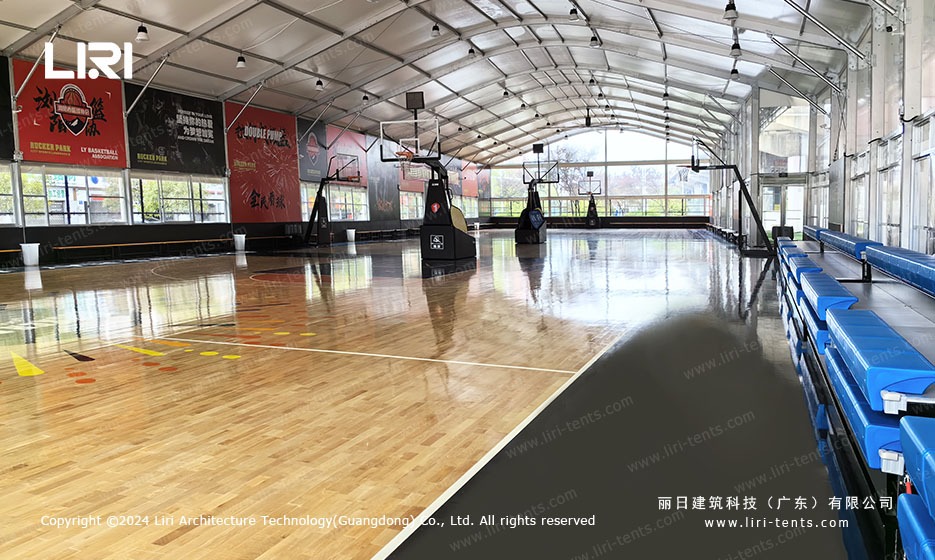
The basketball installation shown here uses a heavy-duty aluminum frame with an arched roof profile. The frame resists wind loads that would stress lighter fabric structures. Aluminum frame marquee structures resist corrosion and maintain structural integrity across decades of assembly and disassembly cycles.
Marquee Tent Design for Indoor Athletics
A marquee tent serving sports carries design differences from a party or wedding tent. Ventilation matters more. Floor loading exceeds standard requirements. Acoustics affect gameplay. The commercial event marquees wholesale category includes engineered variants built specifically for these demands.
This project shows several sport-specific adaptations:
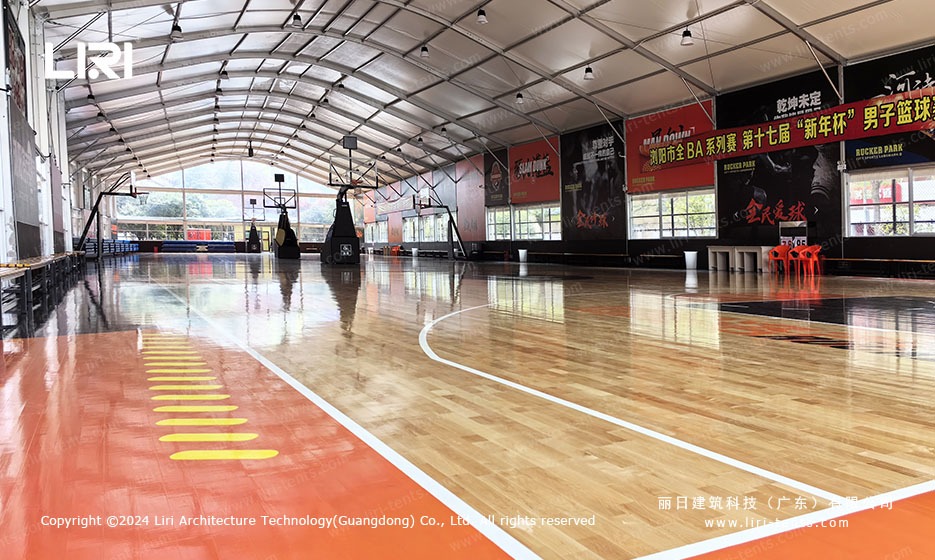
Professional Sport Flooring: The surface mimics indoor hardwood basketball courts. Standard marquee flooring cannot absorb the impact and lateral stress of competitive play. Reinforced subflooring with proper shock absorption protects athletes’ joints.
Transparent Sidewalls: Natural light reduces daytime lighting costs. The sidewall panels here combine weather protection with high light transmission. Players see clearly without glare.
Overhead Lighting Grid: A suspended lighting system hangs from the aluminum trusswork. Courts need uniform illumination measured in lux, not subjective brightness. The open truss design supports lighting placement across the full ceiling plane.
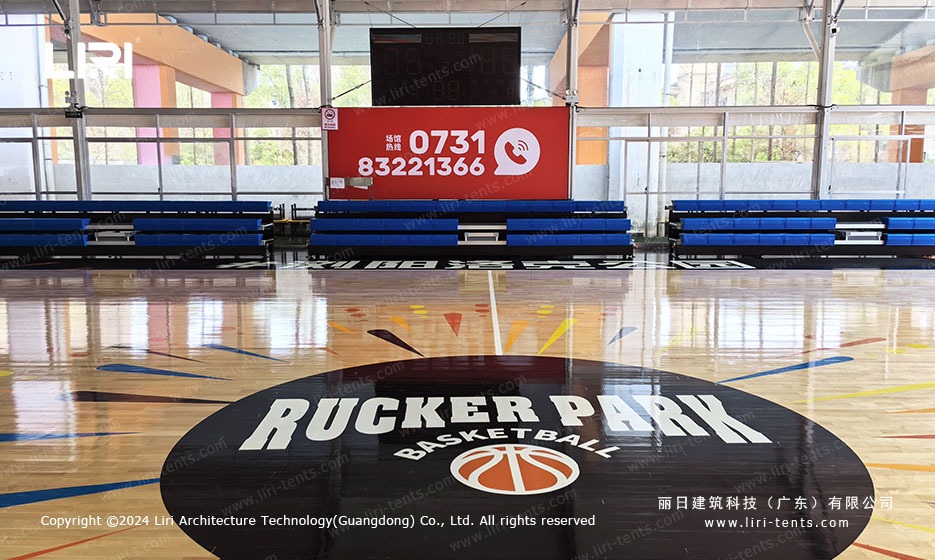
Bleacher Seating: Side seating runs the court perimeter. The marquee width accommodates both the regulation court and spectator rows without crowding.
Aluminum Frame vs. Steel for Sports Marquees
Facility operators choosing between aluminum and steel frames should compare weight, corrosion, and assembly speed. Aluminum frame marquee structures weigh roughly 60% less than equivalent steel profiles. Crews assemble sections faster. The material forms a natural oxide layer that prevents rust without paint or coatings.
Steel costs less upfront but adds long-term maintenance. Repainting, rust repair, and heavier lifting equipment raise total ownership costs. For a modular marquee tent assembly that may relocate to different sites, aluminum delivers lower transport and labor costs per cycle.
The Indoor Basketball Marquee Floor
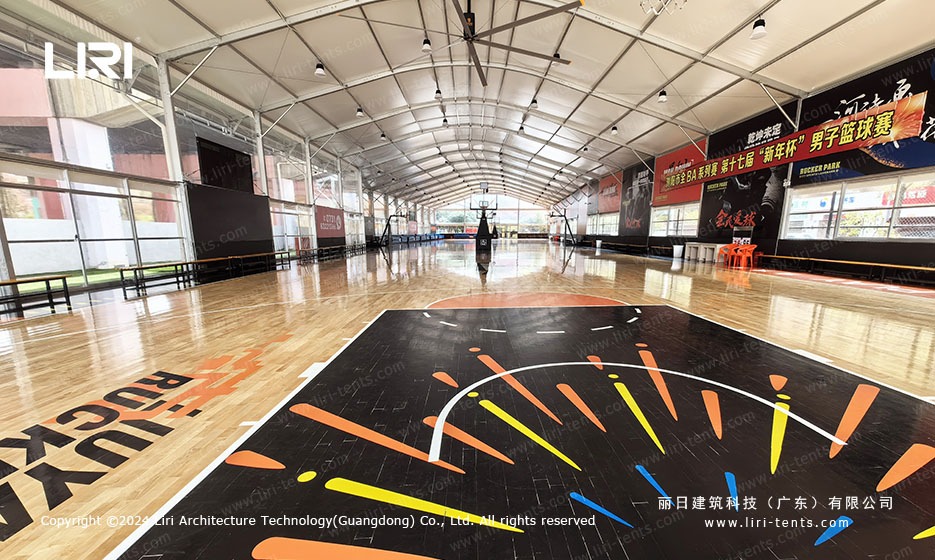
A basketball court demands more than flat ground. The flooring system in this installation uses layered construction:
- Base leveling layer compensates for uneven ground
- Shock absorption layer reduces impact on knees and ankles
- Surface finish provides ball bounce consistency and grip
The court markings follow regulation standards. Painted zones, three-point lines, and key areas appear in crisp white against the dark base surface. The marquee length accommodates two full courts end-to-end, or a single show court with warm-up space.
Commercial Sport Marquee Installation Process
A professional basketball marquee installs in days, not months. The sequence runs:
- Site preparation – grading and foundation layout
- Frame assembly – aluminum truss sections bolt together on the ground
- Roof membrane deployment – PVC fabric stretches across the arch
- Sidewall installation – transparent panels clip into the frame
- Flooring and fit-out – sport surface, lighting, and seating
The modular marquee tent assembly approach means each section connects with standard bolts and brackets. No welding. No specialized tools. A trained crew builds the frame in 48 to 72 hours depending on span width.
Heavy duty marquee tents for sale in the commercial sporting category typically span 15 to 30 meters in width. The structure here sits at the wider end of that range, allowing full regulation play with comfortable perimeter space.
Marquee Tent Sports Applications Beyond Basketball
The same clear span architecture works for volleyball, badminton, tennis, and multi-use gymnasiums. A sporting event marquee structure adapts through flooring changes and net mounting points. Tournament organizers use these structures for temporary competition venues. Schools add indoor capacity without building permanent halls.
Some operators configure a single marquee for seasonal use. The structure stands during the academic year and stores during summer break. The modular assembly makes this seasonal rotation practical. Others leave the marquee in place year-round as a semi-permanent sports facility.
Climate Control Inside a Sports Court Marquee
Heating and cooling a large volume presents challenges. The arched roof profile helps. Hot air rises and vents through ridge openings. In cold conditions, insulated sidewalls and forced-air heating maintain playable temperatures. The clear span design leaves no structural obstructions for HVAC duct routing.
Natural ventilation through mesh and transparent sidewalls reduces humidity buildup. Basketball is a high-exertion sport. Players need air movement. The sidewall configuration shown here balances weather protection with airflow.
Marquee Tent Maintenance for Sports Facilities
Operators should inspect the aluminum frame annually for connection tightness. PVC roof fabric needs cleaning to prevent algae and dirt accumulation. Sport flooring requires periodic refinishing depending on usage intensity. With proper care, the aluminum frame lasts 20 years or more. The PVC membrane typically serves 10 to 15 years before replacement.
FAQ
What is the typical span for a sports court marquee?
A standard basketball court with perimeter space needs 20 to 30 meters in width. Length varies based on whether the facility houses one or two courts. Most installations use clear span marquee tents at the upper end of this range to avoid interior columns.
How does an aluminum frame marquee structure compare to a permanent building?
An aluminum frame marquee costs 40% to 60% less than conventional construction and installs in weeks rather than months. It lacks the thermal mass of brick or concrete, but modern insulation and HVAC systems close the comfort gap. For operators needing fast capacity without permanent capital commitment, the marquee model wins.
Can a basketball marquee handle strong winds?
Engineered sports marquees carry wind load certifications for 100 km/h or higher. The key factors are anchoring quality, frame gauge, and roof membrane tension. A properly installed heavy-duty marquee withstands conditions that would damage standard party tents.
What flooring works inside a basketball marquee?
Professional sport flooring with shock absorption and consistent ball bounce delivers the highest performance. Budget installations sometimes use vinyl over plywood, but competitive play demands the layered systems designed for indoor athletics. The flooring adds cost but protects players and extends facility life.
How long does commercial sport marquee installation take?
A trained crew completes a mid-size basketball marquee in 3 to 5 days from foundation to final fit-out. Larger spans with complex HVAC and lighting may extend to one week. This compares favorably to the 6 to 12 months typical for permanent construction.
Can a sports court marquee stay up year-round?
Yes. Many facilities operate sports marquees as semi-permanent structures. Annual inspections, proper anchoring, and membrane maintenance keep the structure safe through all seasons. The aluminum frame resists corrosion, and the PVC roof withstands UV exposure across years of continuous use.
 29m x 40m Electric Retractable Basketball Court Marquee for Lock Park Sports Facility
 Purple Gable Twin Peak Marquee | Two Retractable Roof Bays Over a Rooftop Basketball Court
 Sports Marquee for Basketball Courts | Event Marquee for Sale
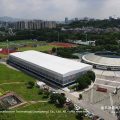 20m x 118m TFS Curve Structure Tennis Court Marquee for 8-Court Sports Park
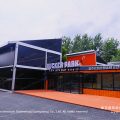 Badminton Court Marquee | Year-Round Sports Hall Solution
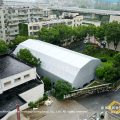 18.5m x 36m Polygon Tennis Court Marquee PG18.5×36-600 | Clear-Span Aluminum Sports Hall