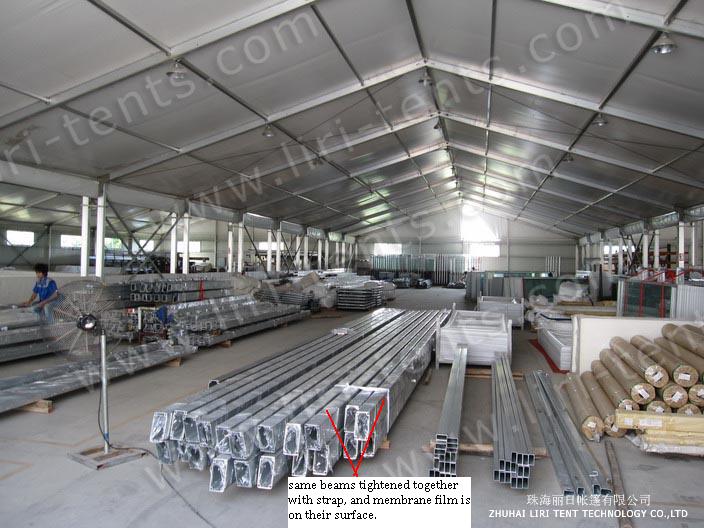
The container doors close at the factory and the next time anyone sees the order is on a wet yard at the destination port. Everything the buyer could still influence, the packing hierarchy, the loading plan, the claim evidence, was settled weeks earlier on paper. This article is the audit checklist for that paper: what a marquee container loading plan must contain, what the packing list has to show, and what to do in the first hour after devanning if something inside is not right.
What Actually Rides in the Box?
A complete marquee order splits into four component families, and each one needs different protection in transit. Extruded aluminium frame profiles travel in strapped bundles with edge protection and wrap film against abrasion. Roof and wall membranes fold into heavy carry bags, where folding pressure and coating scuffing are the two failure modes worth asking the supplier about. Steel connectors, bolts and anchoring hardware go in labelled cartons, and rigid elements such as glass walls or doors ride in timber or steel crates.
The audit question for each family is simple: who opens what, in what order, at the destination, and how will each package be identified? If the supplier cannot answer that in the loading documentation, the unloading crew will improvise, and improvised unloading is where most avoidable transit damage starts. Ask for the packing hierarchy per component family in writing, not as a verbal assurance at contract stage.
Which Numbers Should a Loading Plan Contain?
A loading plan is checkable only if it shows positions, not just totals. The published nominal envelope of a 40ft high-cube container gives you the arithmetic to sanity-check it:
| Parameter | Nominal published figure |
|---|---|
| Internal length | 12.03 m |
| Internal width | 2.35 m |
| Internal height | 2.69 m |
| Door opening (w x h) | approx. 2.34 x 2.58 m |
| Payload limit | approx. 26,500 kg |
These are nominal published figures for the container type, not a promise about the specific box that arrives; verify against the carrier’s equipment. Use them as ratios. A loading plan that claims a bundle of 12-metre roof beams fits a box with a 12.03-metre internal length has left no margin for dunnage, and a plan whose total weight approaches the payload limit must show how the mass distributes across the floor. Under SOLAS, the verified gross mass of the stuffed container must also be declared before loading, so the VGM figure should reconcile with the packing list weights.
When Does a Roof Beam Need a Flat Rack?
The connection between span geometry and freight mode is the part of an export order buyers most often miss. The marquee specification fields that define span, bay distance and profile sections also decide the longest single component in the order. Where a component exceeds what the door opening and internal length allow, it cannot ride inside a standard box; it moves on a flat rack or open-top unit at a different freight rate, or the design uses shorter joined sections.
Ask the supplier to state the longest component length in the order and the planned freight mode for it, before production starts. Large-span projects show why this matters: how a long-span structure is engineered at hangar scale has a completely different component-length profile from a 15-metre event marquee, and the freight plan should be designed around that reality rather than discovered at the port.
What Must the Packing List Show?
A packing list that reads “frame, 1 lot” is worth nothing at devanning. The document should enumerate packages at unit level: each bundle, carton and crate with an identifier that matches a physical label, its contents by component family, quantity and gross weight. Where wood packaging is used, the timber must carry the ISPM 15 treatment mark, the international standard for wood packaging material in cross-border shipments; a missing stamp can hold an entire container at customs.
Two more items deserve explicit lines. First, the document set should identify the customs tariff classification for the goods so destination brokers can pre-clear. Second, for buyers whose cargo consolidates or transships, regional routing changes what the packing list must survive: consolidation routes across the Middle East and similar hubs mean packages are handled more often, which raises the value of unit-level labelling every time the container is crossed.
Who Pays When a Crate Arrives Damaged?
Liability was fixed the moment the chosen Incoterm transferred risk, long before the damage was visible. The buyer’s job after that point is evidence, not argument. At the destination yard, photograph the container seals and the exterior condition before cutting anything. At devanning, photograph each package before opening it and keep the packaging material; a surveyor who cannot see how a crate failed cannot attribute the failure to carriage. Notify the carrier and the insurer within the claim window stated on the bill of lading, which is often short.
This is also where freight scope returns to the commercial file. The way freight scope changes a quotation comparison decides whether packing, marine insurance and destination handling were ever in the price, and a claim procedure only works when someone actually carried that risk. Reconcile the two documents against each other before signing, not after the first transit incident.
How Should the Receiving Site Be Prepared?
The last failure point is the buyer’s own gate. Unloading order should match installation order, so the frame bundles come off first and the membranes last, not buried under the hardware cartons. Confirm the offloading equipment in advance: a reach truck or telehandler that can handle the longest bundle at the weight shown on the packing list, and ground that a loaded truck can stand on. Site access constraints belong in the original enquiry for the same reason span geometry does.
Once off the truck, packages need dry, organised storage until the storage checklist before installation takes over. While the bundles are still strapped, a visual pass over the frame against the packing list costs minutes and protects a claim that may be worth a full membrane set.
If you want the loading plan, packing list and receiving schedule reviewed against your site before production starts, send the site address, offloading equipment and installation window with your enquiry.
 Marquee Price per Square Metre: What the Figure Hides in a Quotation
 Buy a New Marquee or Expand an Existing Hire Fleet?
 12m Clear Span Marquee for Sale
 29m x 40m Electric Retractable Basketball Court Marquee for Lock Park Sports Facility
 Custom Span Marquee Tents: Specifying a Made to Order Width
 How to Keep Event Marquee Warm in Winter?