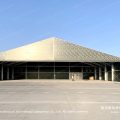
Maintaining aircraft needs covered space, and building a permanent hangar is slow and expensive. A curved TFS hangar tent is the faster alternative: a high roof structure that protects helicopters and small aircraft during maintenance, storage, and transit between bases. The design trades brick and steel for an aluminum frame and PVC cover that goes up in weeks rather than months.
The curved roof is the key feature. It creates generous headroom over the aircraft without the wasted space of a flat roof, and it sheds rain and snow cleanly. A tent of this type provides the enclosed space a maintenance team needs while remaining fully demountable if the operation moves.
Structure and Wind Performance
The frame is built from strong aluminum profiles with a fire-retardant PVC fabric cover. Together they resist wind speeds up to 100 km/h in the standard configuration, and the structure can be specified for higher loads depending on the site. The frame sections are designed for flexible configuration, so the same system adapts to different spans and lengths.
For aircraft, the dimensions are matched to the fleet. Hangar tents are manufactured in various sizes according to the aircraft being housed, so a helicopter operation and a small fixed-wing operation use the same system with different spans. Large span flexible lifting doors give access for the aircraft, and sandwich panel walls provide insulation and a secure enclosure. The same approach is documented in aircraft hangar marquee solutions for larger aviation sites.
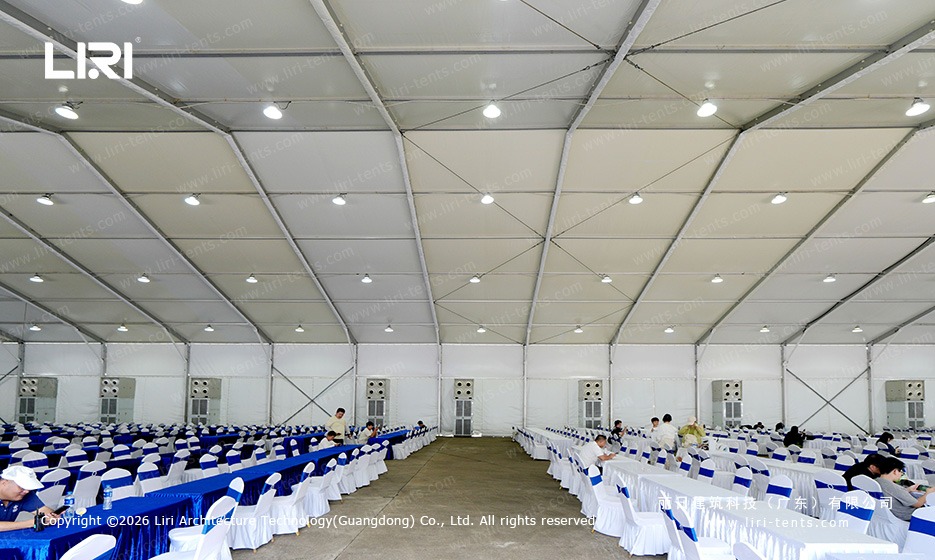
Accessories for a Working Hangar
A hangar tent is only useful if it works like a building. Optional equipment includes insulated roof covers, insulated sandwich panel walls, large span lifting doors, steel walls, LED lighting, working doors, rolling doors, flooring systems, rain gutters, fire-fighting systems, and ventilation. The list mirrors what a permanent hangar carries, but without the construction time.
Fire protection and ventilation deserve attention. Fire-fighting systems are specified to local rules, and ventilation keeps the interior workable during maintenance shifts. Flooring protects the tent floor and makes the space easier to keep clean, which matters for maintenance work. Operations that need to relocate can use a modular aircraft shelter hangar design, because the compact packed sections let one crew move the whole building to a new site.
Transport and Assembly
One of the main advantages of a hangar tent is how it packs. The frame sections break down into small transport units that fit standard containers, so shipping is straightforward and the structure can be assembled and disassembled repeatedly. A crew that knows the system can erect a hangar in days, including the doors and wall panels.
That repeatability also changes how operators plan. A temporary base can be set up for a season and removed, or the structure can be moved between sites as contracts change. Because the system is modular, a later expansion is done by adding bays rather than rebuilding. The same curved frame family covers a large span curved marquee structure for sports halls and logistics buildings.
Frequently Asked Questions
What wind speed can a curved hangar tent withstand?
Standard configurations are rated for wind speeds up to 100 km/h, and the structure can be engineered for higher wind loads on exposed sites. The actual limit depends on the anchoring, so the ground fixing method is specified together with the frame.
Can a hangar tent be moved to a different site?
Yes. The frame packs into compact transport units and the structure is fully demountable. A crew can disassemble the hangar, ship it, and re-erect it at a new location, which makes it suitable for temporary bases and relocating operations.
What sizes are available for aircraft hangar tents?
Hangar tents are manufactured to match the aircraft, so spans vary widely from small helicopter shelters to large clear span halls. The width and length are configured from modular sections, and the roof height is set by the curved frame design.
Do hangar tents need fire protection and insulation?
For most operations, yes. Insulated sandwich panel walls control temperature and condensation, and fire-fighting systems are fitted to local regulations. Ventilation keeps the interior safe during maintenance work. These are specified as options with the structure. For a mid-size alternative, a TFS sports marquee structure shows the same frame system applied to a different industry.
→ Browse 25m Clear Span Marquee
 Aircraft Hangar Marquee Tent | Clear-Span Industrial Storage
 20m Eyelid Opening Hangar: High-Performance Modular Aircraft Shelter
 Custom 25x40m TFS Sports Marquee Tent for Basketball Hall
 Large Aircraft Hangar Marquee | Modular Electric Hangar Systems
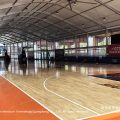 How a Clear Span Sports Court Marquee Created a Year-Round Basketball Arena
 Wedding Marquee Tent – Outdoor Bangkok Reception Venue