Professional military training relies on supporting tents that hold up under repeated setup, hard use, and strong wind. A military-grade tent combines a high-strength aluminum alloy frame with flame-retardant double-sided PVC synthetic fiber cloth, so the structure stays rigid while the cover resists heat, abrasion, and weather. Units are built in spans from 3m to 60m, with lengths extended in 3m or 5m bays to match the mission footprint.
That span range means the same product family covers everything from a small field command post to a full aircraft shelter. movable military warehouse tent shows how the frame design scales when vehicles and equipment need covered parking.
Materials and Fire Safety Standards
The frame uses high-strength aluminum alloy tubes, and the tarpaulin is a retardant double-sided PVC synthetic fiber cloth. The flame-retardant rating meets European standard DIN 4102 B1, M2, which is the benchmark for public and institutional use. Color options include army green, white, and camouflage, letting procurement match the tent to the environment or the unit’s standard kit.
Standard sizes include 6x12m, 8x15m, 15x25m, and 40x80m, with custom layouts quoted per bay. The anchoring system is rated for high wind, and additional ballast or ground anchors can be specified for exposed sites.
Applications Beyond the Training Ground
Military tents for sale are used as temporary command centers, training centers, and field exercise bases, and the same structure serves field reconnaissance, air force base support, and headquarters functions. They also show up in civil roles: medical relief stations, seismic command posts, and disaster housing, where speed of setup matters more than permanence. A military hangar storage marquee is the common choice when the requirement is long-term equipment cover rather than short deployment.
One frame can switch roles between deployments, which is why procurement teams favor the modular approach. The same shelter that housed a training rotation can be re-erected as a supply store within days, keeping the asset utilization high through the year.
Stability and Service Life of a Field Tent
Field conditions punish tents, so the frame is designed for stability under wind load and for fast re-erection after a move. The double-sided PVC cover is UV-resistant and tear-resistant, and the connectors are hot-dip galvanized steel to survive wet and salty environments. With routine inspection of the cover seams and the frame joints, a military tent keeps its performance over many deployment cycles.
For relief and housing work, operators pair the tents with hard flooring and HVAC to create habitable space quickly. outdoor storage workshop marquees demonstrate the same frame family configured for industrial and workshop duty, so a single supplier covers both defense and civil requirements.
Can military tents withstand hurricane-level wind?
Frame tents of this type are engineered for high wind with the correct anchoring, and the rating increases when extra ballast or reinforced pegs are used. For extreme weather zones, the site survey determines the fixing plan, and the cover is tensioned so the roof sheds gusts instead of catching them.
What is the delivery time for a military tent order?
Standard spans ship from stock or short production runs, with custom camouflage prints and door layouts quoted separately. Procurement teams should confirm the production slot during the quotation stage, because large multi-unit orders are scheduled in sequence.
Are these tents suitable for long-term disaster housing?
Yes, with the right accessories. The insulated cover, hard wall option, and cassette flooring turn the shelter into seasonal housing, and the structure is designed to stay up for months at a time. The same frame is also covered under temporary storage clear span tents when the mission shifts from housing to warehousing.
→ Browse Large Storage Marquee Options
 30x60m Curved Marquee: The Future of Robot Training
 29m x 40m Electric Retractable Basketball Court Marquee for Lock Park Sports Facility
 Sanya Formula E Marquee Tent: Multi-Zone Layout for Electric Racing Event
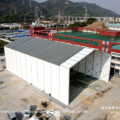 Outdoor Yacht Storage & Workshop Marquees | Flexible Factory Solutions
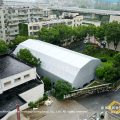 18.5m x 36m Polygon Tennis Court Marquee PG18.5×36-600 | Clear-Span Aluminum Sports Hall