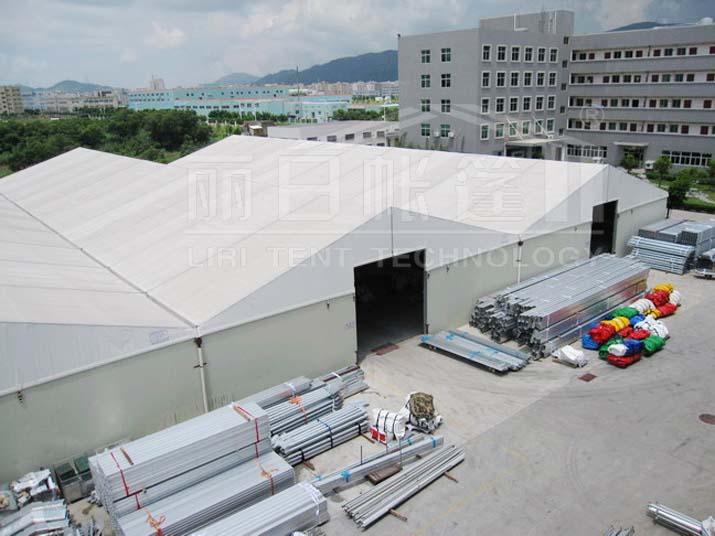
A large storage tent with ABS solid wall turns open ground into a secure, weatherproof store without the cost and delay of a permanent building. The rigid ABS panels replace soft PVC sidewalls, giving the structure a closed, insulated envelope that keeps dust, wind and prying eyes away from the stock inside. Because the frame needs no permanent footing, the same footprint can later be moved, extended or removed as the operation changes.
Logistics managers comparing options usually begin with large storage marquee tents that pair a clear-span frame with hard wall protection. The format keeps the asset liquid while still delivering a professional store.
Why ABS Solid Walls Suit a Large Storage Tent
ABS hard walls stand rigid without sagging, so the storage tent reads as a building rather than a temporary cover. The panels clip to the aluminium frame and seal the perimeter, which matters for temperature-sensitive goods and for sites that need a clean, enclosed look.
Compared with soft sidewalls, the solid skin also cuts light and noise transfer, so the interior stays calmer for staff and equipment. Operators planning volume swings often review clear span warehouse storage tents before committing to a fixed lease.
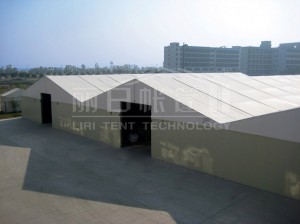
Frame, Cover and Structural Standards
The uprights and roof beams use anodised aluminium alloy rated for continuous outdoor duty, while the PVC roof cover is double-coated polyester that is waterproof and flame-retardant to the European DIN 4102 B1 standard. The clear-span design removes interior columns, so racking and forklifts run in straight lines.
Wind and snow loads are engineered per project, and the structure accepts ground anchors, weight plates or a concrete strip depending on the subsoil. For high-turnover sites the same frame pairs well with industrial warehouse frame tents configured for loading-dock access.
ABS walls can be combined with insulated sandwich panels and ridge ventilation, so the interior stays stable through summer peaks. Teams storing electronics or pharma usually add a small HVAC unit mounted through the gable for precise control.
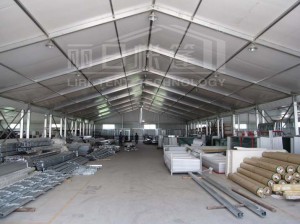
Site Setup and Accessory Options
One reason the format suits storage is that it sits on almost any level surface, from asphalt to compacted gravel to grass, with the right ballast. There is no need to excavate or pour a slab, which removes the largest source of both cost and delay on a tight schedule.
Doors, gutters, lining and floor systems are all modular, so a storage hall and a flexible industrial warehouse marquees display space can share one catalogue of parts. This standardisation keeps spare inventory low across a mixed fleet.
For operations that need hard-wall protection at scale, the same supplier also offers abs solid wall tent systems configured for roller-shutter integration and dock access. That flexibility is why fleets from different industries still draw from a single parts bin.
Frequently Asked Questions
What makes an ABS solid wall better than soft PVC?
ABS hard walls stand rigid and seal the perimeter, blocking dust, light and wind that soft sidewalls let through. The solid skin also gives the storage tent a closed, building-like look that suits secure and temperature-sensitive stock.
How large can a storage tent with hard walls be built?
Clear-span widths run from 3 metres up to 60 metres, with length extended in fixed bays as the store grows. An ABS wall storage tent therefore scales from a small depot to a full logistics hall on the same frame profile.
Is a permanent foundation needed for the storage tent?
No permanent foundation is needed. The aluminium structure is ballasted with ground anchors or weight plates, which keeps the ground reversible and avoids the permits tied to a concrete build.
What insulation options pair with ABS wall storage?
Thermal liner, insulated sandwich wall panels and ridge ventilation can be combined to hold a stable internal climate. Operators storing sensitive goods usually pair the ABS walls with a small HVAC unit mounted through the gable.
→ Browse Industrial Warehouse Frame Tents
 Aircraft Hangar Marquee Tent | Clear-Span Industrial Storage
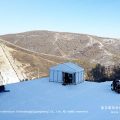 Cold-Weather Event Marquees for Outdoor Winter
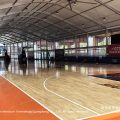 How a Clear Span Sports Court Marquee Created a Year-Round Basketball Arena
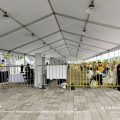 Recent Formula E Shanghai E-Prix Marquee Tent: Multi-Zone Race Village Setup
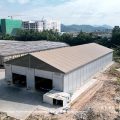 Warehouse Marquees: Flexible Industrial Space Solutions
 Wedding Marquee Tent – Outdoor Bangkok Reception Venue