
Marquee drawing revision control keeps a purchase tied to the configuration that the buyer, supplier and installation team have actually reviewed. A quotation drawing can establish the initial arrangement, but a later door move, wall change or service opening may affect more than the page on which it appears. Before production or installation proceeds, the team needs a clear record of which documents apply and which questions remain open.
This guide proposes a buyer’s document-control process. It does not prescribe a manufacturer’s engineering procedure or confirm a particular structure’s suitability.
Give each drawing a job beyond showing the shape
Start with the project-specific marquee specification requirements. Identify the arrangement, structural series, bay layout, enclosure and site interfaces that need documentary confirmation. Keep dimensions and their reference points explicit: clear span, overall width and the distance between repeated frames should not share an unexplained label.
A useful drawing register records the document number, title, revision, issue date, purpose and responsible reviewer. Add the quotation or order reference so the commercial team can connect the drawing set to the purchase. Record dimensions in their stated units; a change from metres to feet should never be inferred from a filename.
ASME’s Y14 standards catalogue includes a standard concerned with revisions to engineering documents. That establishes revision identification as a formal engineering-document subject. The working record below is a proposed procurement tool, rather than a claim of compliance with that standard.
Separate a review copy from a released configuration
Agree with the supplier how each issue is described. A drawing sent for discussion may contain unresolved dimensions or interfaces. Record those questions alongside the file instead of letting the presence of a drawing imply that fabrication or site work has been approved.
Use an issue record that makes the intended next action unambiguous:
- Issued for comment: identify the questions and the person expected to answer.
- Ready for the agreed release decision: identify the configuration and the required reviewers.
- Released for the stated activity: record who authorized that activity and which documents were included.
- Superseded: retain the history while removing the old issue from the active working set.
These are suggested descriptions. Use the contractual and engineering approval terminology agreed for the actual project. A buyer’s acknowledgement of a room layout does not replace structural review or a local approval.
Test a change across the whole document set
Consider an illustrative request to relocate an entrance after the initial arrangement has been circulated. The buyer should ask which drawings, enclosure items, floor interfaces, packing references and installation instructions need review. The supplier determines the actual technical consequences; the example is not evidence that a specific door can be moved.
Record the proposed change, its reason, affected documents, review responsibility and the written response on cost or programme. Keep the change open until the responsible parties have confirmed the consequences. If production has already started, ask which components or batches are affected before accepting a revised delivery commitment.
Forwarding one replacement PDF is a weak handoff if the packing list still points to an older arrangement. Check the references in both directions: from the change to its documents, then from each revised document to the order and affected components.
Carry the released set through production and dispatch
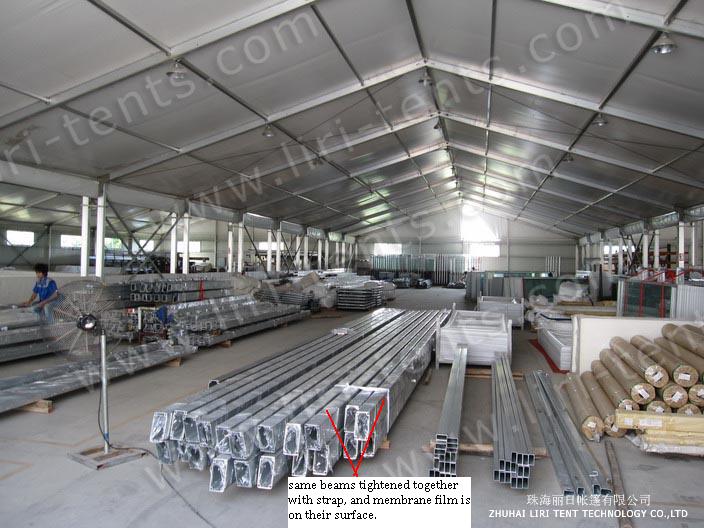
The factory reference image identifies the manufacturing context; it does not demonstrate a particular order’s release checks. During a factory audit, ask how the agreed drawing issue reaches the people preparing the order. Before dispatch, use the pre-shipment inspection checklist to compare the finished package with the accepted specification and document set.
For installation handover, supply an accessible current-document list, the released files, outstanding restrictions and the contact responsible for queries. Keep superseded copies as history, clearly outside the active set. Record any site change and return it through the agreed review route rather than annotating a print and assuming every team has seen it.
Send your marquee configuration and document questions when preparing an order, so the drawing, specification and handover scope can be discussed together.
 Marquee Pre-Shipment Inspection: A Buyer Checklist Before Balance Payment
 Marquee Factory Audit: What to Check Before You Place the Order
 Wind and Weather Planning for Commercial Marquees
 Marquee Price per Square Metre: What the Figure Hides in a Quotation
 Marquee Membrane Cover Replacement: When to Re-Cover and How to Order the Right PVC
 Marquee Container Loading and Export Packing: A Buyer Checklist