Every year, people are killed or injured by tents that were used unsafely in severe weather, and nearly all of those incidents could have been avoided with the right knowledge and safe practices. The two facts that matter most are simple: know what wind speed your tent can withstand, and anchor it correctly on ground that will hold. Event planners who build these habits into their checklist protect their guests and their equipment in one move. For crews running events through a windy season, the same discipline shows up in wind planning for event organizers.
Know Your Tent Wind Rating Before Setup
Read the installation manual before you start, and make sure every crew member understands what the tent is rated for. The manual tells you the maximum wind speed the structure can take and how the anchoring must be arranged to reach that rating, and a tent that is under-anchored will fail well below its number.
Wind resistance varies with the tent dimensions: a large span catches more surface area, so a big hall needs more anchors and closer spacing than a small canopy of the same design. Confirm the rating against the forecast at the site, not at the office, because local topography changes how wind behaves.
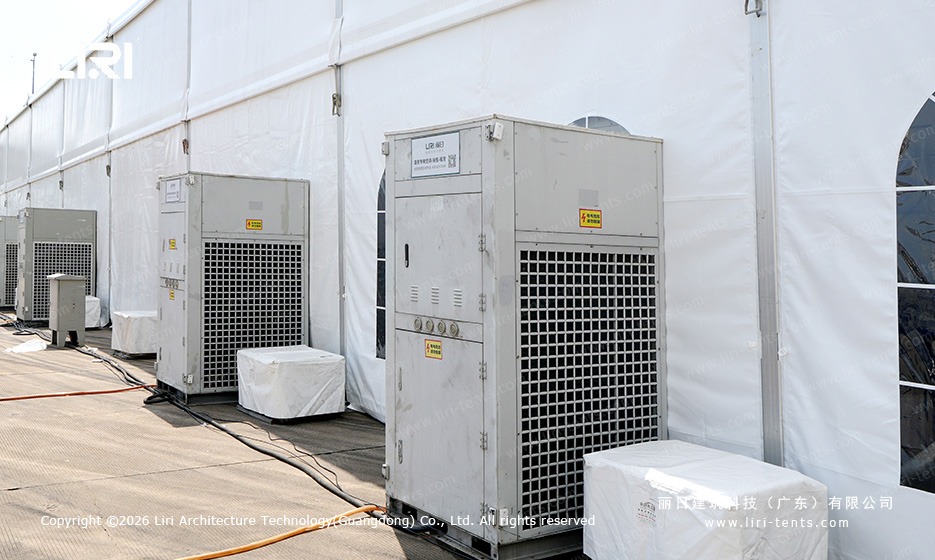
Anchoring Rules for High Wind Conditions
Tents should be fixed on stable land whose maximum wind resistance matches the structure’s dimensions. Use the specified ground anchors, weight plates or ballast in the positions shown in the manual, and never substitute lighter anchors to save setup time because the whole margin disappears with them.
On hard surfaces where stakes cannot penetrate, weight plates are the correct answer, and their mass must be sized to the tent rating, not to what is available on site. The same anchoring logic applies to hard wall church marquee structures, which add rigid walls but still depend on a correct base for wind stability.
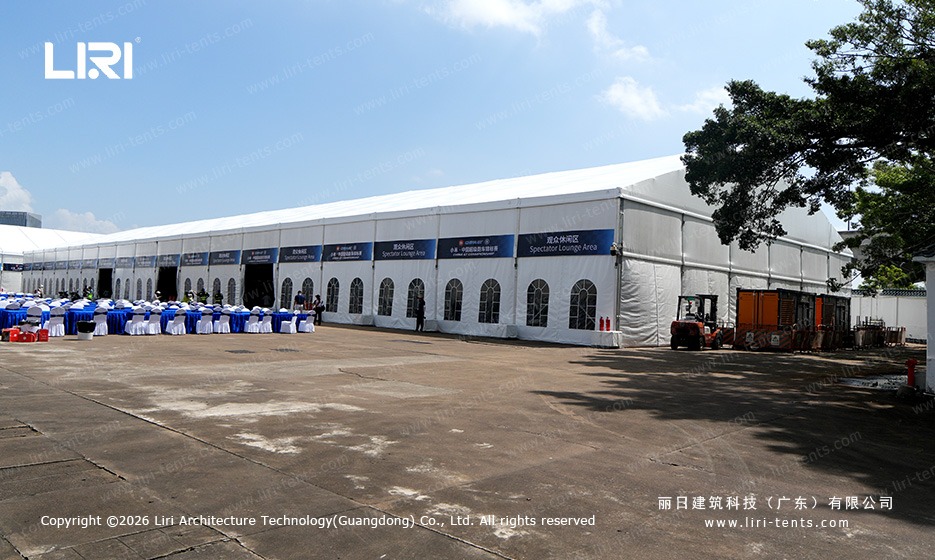
When Wind Forecast Makes Installation Unsafe
As a general rule, it is forbidden to install and use the tent when wind speed reaches grade 7 on the Beaufort scale, which corresponds to around 50 to 61 km/h. Below that level, the decision depends on the specific tent rating, the anchoring quality and how exposed the site is, so treat the grade 7 threshold as the hard stop and plan your own margin under it.
Understand the relationship between wind speed and the surface area of the tent: doubling the exposed area roughly doubles the force on the anchors, which is why long halls need the heaviest anchoring. For large gatherings, the same margin thinking applies to large secure church marquee setups where a failure would put hundreds of people at risk.
Frequently Asked Questions
What wind speed can a marquee tent handle before it becomes unsafe?
That depends on the tent model, span and anchoring, so check the installation manual for the exact rating. As a hard rule, installation and use are forbidden once wind reaches grade 7, roughly 50 to 61 km/h, and most operators set their own stop threshold lower than that.
When should a tent not be used in high wind?
Do not install or use the tent when the forecast reaches grade 7 or above, when the site is exposed with no natural shelter, or when the ground cannot take the specified anchors. If any of these conditions are present, postpone the setup rather than risk a structural failure.
How do I anchor a marquee tent for windy conditions?
Follow the manual exactly: use the specified ground anchors or weight plates, space them as shown, and verify every anchor is set before guests arrive. Anchored clear span marquee structures rely on the same principle at larger scale.
Can a tent stay up overnight in windy weather?
Only if the forecast stays within the tent’s rating and the anchors were set per the manual. When a storm is expected overnight, the safest option is to strike the tent before dark, because nobody can re-tension a structure safely once the wind arrives.
→ Browse secure marquee options for large events
 Aircraft Hangar Marquee Tent | Clear-Span Industrial Storage
 Cold-Weather Event Marquees for Outdoor Winter
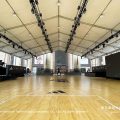 25m Clear Span Exhibition Marquee: Shanghai Urban Plaza Sports Arena
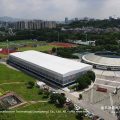 20m x 118m TFS Curve Structure Tennis Court Marquee for 8-Court Sports Park
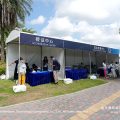 Race Track Marquee Tent | Spectator Lounge and Multi-Zone Race Village for a GT Championship Weekend
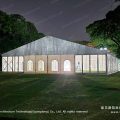 Wedding Marquee Tent – Outdoor Bangkok Reception Venue